
The high-voltage Malabar exercise featuring the navies of all four Quad countries -- India, the US, Australia and Japan -- began on Thursday off the coast of Guam against the backdrop of a resolve by the four nations to solidify cooperation for a free and open Indo-Pacific in view of China's rouge behaviour in the region.
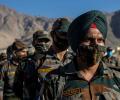
In a strong response to China's objection to development of infrastructure on the Indian side of the LAC, New Delhi also asserted that Beijing has no locus standi to comment on India's internal matters.
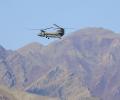
For both India and China, the most likely option -- and the most challenging -- appears to be a freezing of the status quo.
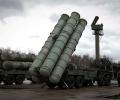
RInstead of disengagement, the Indian and Chinese armies have deployed an estimated 35,000 to 40,000 soldiers each along the LAC. The PLA has deployed S-400 air defence missiles to neutralise the IAF's advantage in air power

'The Indian army is a professional army. They can handle such a situation'
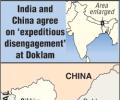
'While overall this is a face saving deal just before the BRICS meeting in Xiamen, any forward military movement at Doklam once again could bring the two Asian giants at loggerheads,' says China expert Srikanth Kondapalli.

Indian-American Haley, in an interview to Fox News, said the Chinese were quiet and strategic during her tenure at the UN. They moved and made sure that they were trying to get positions in certain areas, and trying to get things done behind closed doors, she said.
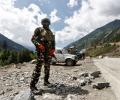
'How Xi Jinping will withdraw the aggression and justify it to his Communist party in case of a negotiated settlement might be his biggest headache.' 'Unless he is ready to gamble on an armed conflict, whose outcome given India's battle-readiness and determination is always uncertain,' observes Virendra Kapoor.

Defence ministers of India and China will hold talks in New Delhi on Tuesday during which they are expected to take a decision on resuming the military exercises of their Armies stalled since 2010.
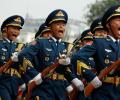
'We are beginning to see that the rest of the world will not simply accept the domination of one power'
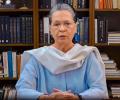
In her introductory remarks at an all-party meeting convened by Prime Minister Narendra Modi on the situation along the Line of Actual Control, Gandhi posed a set of questions to the government, asking specifics about when Chinese troops intruded into the Indian territory in Ladakh and whether the country's external intelligence agencies did not report any unusual activity there.
'Our strategy should be to 'hold the line' in the north on the Sino-Indian land frontier, but maintain and, if possible, enlarge India's current edge in the maritime south.'
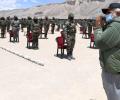
'By not even acknowledging China's occupation of Indian territory Modi signalled to Beijing that he was not prepared to used forceful means to vacate the Chinese occupation, and that his government was reconciled to this loss of territory and accepted the fait accompli engineered by the PLA.'
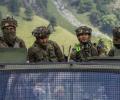
'The leverage created by the Indian military must not be lost.'

The official cited it as an example of 'how the Chinese military is trying to resolve issues through dialogue mechanisms'.

China will use airpower to support Pakistan from the start of a war. China will use the opportunity to at least take Ladakh. Its growing navy will prevent India from blockading or attacking the Makran Coast. And thanks to Chinese weapons, Pakistan keeps expanding its forces, observes Ravi Rikhye.

In anticipation of a verdict to be delivered by the International Tribunal of the Permanent Court of Arbitration in The Hague on Tuesday, China has orchestrated a worldwide campaign to defuse its findings.

'India was in no position to wage another war in 1965, having suffered a morale-shattering defeat in 1962. The three services were in the middle of a modernisation and expansion phase and therefore not fully trained or battle-ready.'

'The border standoff, if not properly addressed by both sides, could escalate to a conventional or sub-conventional conflict between India and China,' predicts Srikanth Kondapalli, one of India's leading China experts.

Until last month more than two-thirds of the Indian Army was deployed against Pakistan. Of 14 army corps, just four-and-a-half faced China, while more than twice that number was ranged against Pakistan.

The only way to resolve the current military standoff along the Line of Actual Control in eastern Ladakh was for Beijing to realise that trying to 'change the status quo by resorting to force or coercion, is not the right way forward', India's ambassador to China Vikram Misri said in a hard-hitting interview to PTI.
China has denied reports that Southeast Asian nations are building up their militaries and edging closer strategically to the United States as a hedge against the Communist nation's rise.The latest data released by the Stockholm International Peace Research Institute shows that weapon purchases in the Southeast Asian region almost doubled between 2005 and 2009.

Access to Sabang Port will allow the Indian Navy to dominate Malacca Strait more effectively, reports Ajai Shukla.

'With the recent challenging of the notion of the Indian Ocean Region being India's strategic backyard, China is gradually upping the ante in the maritime realm around India.'
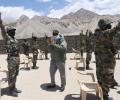
Only he, with his tremendous political capital and personal stature, can pull it off, observes B S Raghavan, the veteran civil servant.

India must also not rule out dialogue with Pakistan. However, talks with Pakistan must be structured, and further progress must be based on visible results.
'Indian diplomacy faltered amidst multiple failures of statecraft.' 'The functionaries responsible must be held to account for their abject failure,' asserts Ambassador M K Bhadrakumar.

The talks took place in a beach resort in Benaulim on the sidelines of a meeting of the Council of Foreign Ministers of the Shanghai Cooperation Organisation.

The sources also said both the Indian and Chinese troops are firmly holding on to their respective positions at the Line of Actual Control.
Since the June 15 clash, the PLA has inducted large numbers of troops, armoured vehicles and artillery along the LAC, from Depsang and Galwan in northern Ladakh to Hot Springs, Pangong Tso, and Chushul in central Ladakh, to Demchok and Chumar in southern Ladakh.

He is only the agent that can bring them that change for they are quite aware that he has articulated no vision on how to set Pakistan back on the rails, notes Lieutenant General Gautam Moorthy (retd).

Being with Russia means being on the wrong side of history and Kyiv wants closer and deeper relations with New Delhi, Ukraine's First Deputy Foreign Minister Emine Dzhaparova said on Tuesday while suggesting that the Russian invasion has lessons for countries with 'difficult neighbours'.
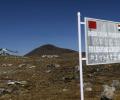
Projecting the mining operations as part of China's move to take over Arunachal Pradesh, the report said 'people familiar with the project say the mines are part of an ambitious plan by Beijing to reclaim South Tibet'.
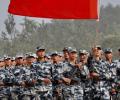
Even though troops of India and China have disengaged at three locations in Eastern Ladakh, the Indian side is clear that the tensions on the borders would be done away completely only when the People's Liberation Army de-inducts more than 10,000 troops along with artillery and tank regiments deployed on its side of the Line of Actual Control near the Indian territory.

'Xi's emphasis on enhancing conventional military deterrence capabilities, joint operations and power projection are likely to increase friction points with India as with other nations,' points out China expert Srikanth Kondapalli.
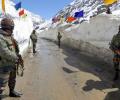
'They cannot use firearms.' 'They have to be restrained.' 'It is a game of patience and chess board moves.' 'It is not like India and Pakistan where bullets get fired and people get killed.'

The US actions can be seen as a riposte to India's neutral position on the Ukraine crisis, its continuing import of Russian arms and oil thus undermining Western sanctions, argues Colonel Anil A Athale (retd).

'China, which had earlier blockaded New Delhi's bid to join the Nuclear Suppliers Group by citing the nuclear non-proliferation law, finds itself in an awkward position and international isolation.' 'India needs to pursue a policy of mediation between China and the Southeast Asian countries for regional security,' says Srikanth Kondapalli.
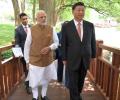
'India's preference today seems to be to exploit the deepening chill in relations with China to breathe new life into its meandering partnership with the US,' argues Ambassador M K Bhadrakumar.

'However, a lot of preparatory work would have to go in and China must be prepared to announce an end to the standoff by disengaging from the remaining areas along the LAC.'
